The energy behind eSports
How smart buildings support the future of competitive gaming
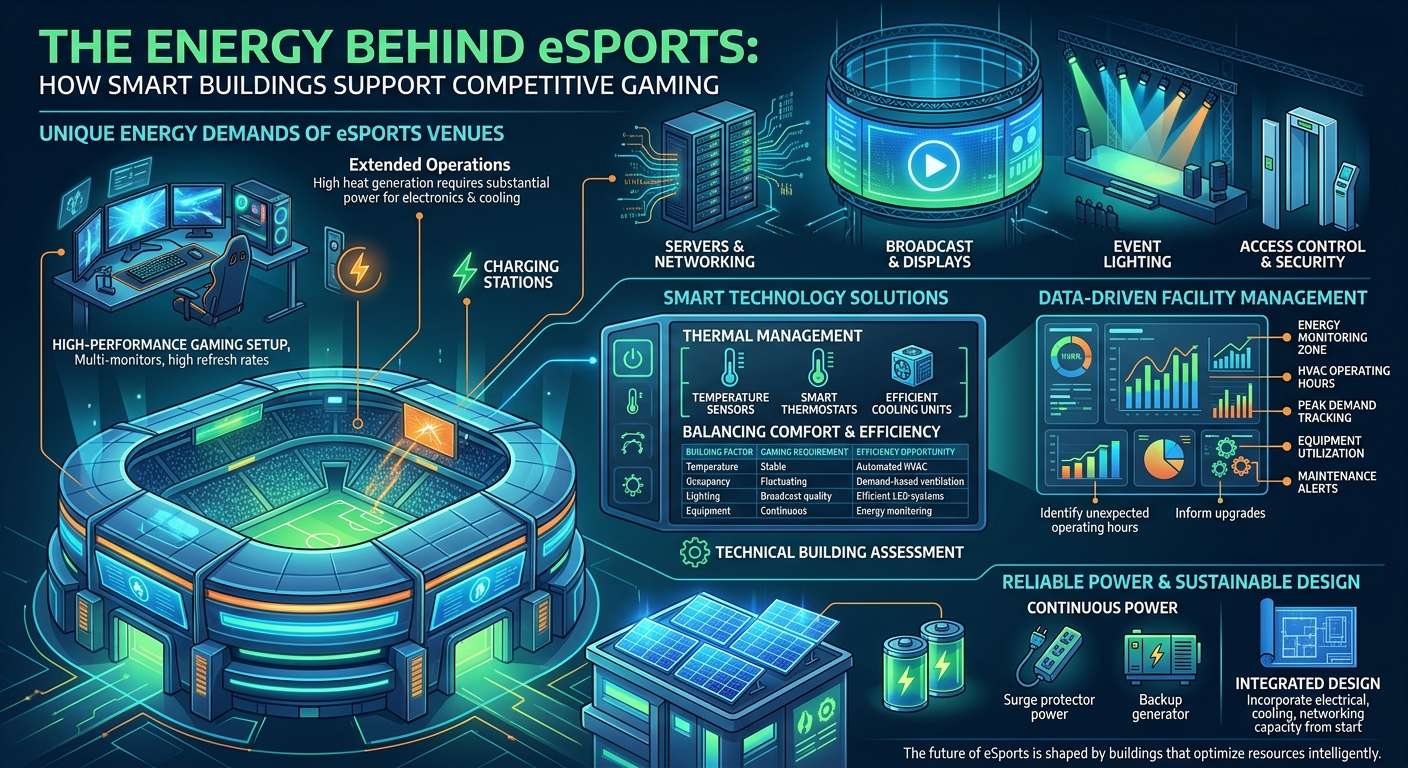
Competitive gaming has evolved from a niche hobby into a sophisticated digital entertainment industry. Modern eSports events depend on much more than powerful computers and skilled players; they also require reliable electricity, climate control, networking infrastructure, lighting, security, and carefully designed physical spaces. As the industry grows, the efficiency of the buildings supporting these activities becomes an increasingly relevant consideration.
An eSports venue may look very different from a traditional office or residential property, but it faces many of the same energy-management challenges. Computers, monitors, servers, cooling systems, displays, and networking equipment can operate for extended periods, creating substantial demands on the building’s electrical and thermal infrastructure. Understanding this relationship helps explain why energy efficiency and smart-building technology are becoming relevant to the broader gaming ecosystem.
The digital side of gaming also connects with adjacent entertainment sectors, including online platforms such as Noxino. While these services operate primarily through digital infrastructure, their wider ecosystem still depends on physical facilities, data networks, and energy-intensive technology. This makes the relationship between digital entertainment and efficient infrastructure worth examining from a business and technology perspective.
Why eSports Venues Have Unique Energy Demands
A conventional office may have computers operating during standard working hours, while an eSports venue can require technology to function during tournaments, training sessions, broadcasts, and public events. High-performance gaming equipment can generate significant heat, which increases the importance of effective ventilation and air-conditioning systems.
The energy requirements can come from several sources:
- Gaming computers and high-refresh-rate monitors
- Servers and networking equipment
- Large video displays and broadcast systems
- Air-conditioning and ventilation
- Stage and event lighting
- Security and access-control systems
- Charging stations and auxiliary equipment
Managing these systems individually can make energy consumption difficult to understand. A more integrated approach allows facility managers to consider the building as a complete technical system.
The Importance of Thermal Management
Heat management is particularly important in gaming environments. High-performance processors and graphics cards generate heat during intensive workloads, while large groups of people can also increase indoor temperatures.
Air-conditioning therefore plays an important role in maintaining suitable conditions for both players and equipment. However, operating cooling systems continuously at maximum capacity may not be the most efficient approach.
Smart controls can help adjust indoor conditions according to occupancy, equipment usage, and scheduled events. Temperature sensors and automated systems can provide facility managers with more precise information, allowing cooling requirements to respond to actual conditions.
Balancing Comfort and Efficiency
The objective is not simply to reduce cooling. Players need a comfortable environment, and electronic equipment requires suitable operating conditions.
A balanced strategy can consider:
| Building Factor | Gaming Requirement | Efficiency Opportunity |
|---|---|---|
| Temperature | Stable indoor conditions | Automated HVAC controls |
| Occupancy | Players and spectators | Demand-based ventilation |
| Lighting | Clear visibility and broadcast quality | Efficient LED systems |
| Equipment | Continuous power availability | Energy monitoring |
| Networking | Reliable connectivity | Optimized infrastructure |
| Maintenance | Consistent system performance | Preventive monitoring |
This approach demonstrates why energy certification and technical building assessments can be relevant even to highly specialized entertainment facilities.
Smart Buildings and Connected Gaming Spaces
Smart-building technology can transform the way eSports facilities are managed. Sensors and connected control systems can monitor temperature, humidity, electricity consumption, occupancy, and equipment conditions.
Instead of waiting for a problem to become obvious, facility managers can use data to identify unusual patterns. A sudden increase in energy consumption, for example, could indicate inefficient equipment, unexpected operating hours, or a developing technical issue.
The same principle applies to lighting and ventilation. Automated systems can reduce unnecessary operation when particular areas are empty while maintaining appropriate conditions when tournaments or training sessions are underway.
Reliable Power Is Essential for Competitive Gaming
Energy efficiency should never come at the expense of reliability. Competitive gaming depends on stable electrical power because even a short interruption can affect an entire match, broadcast, or tournament schedule.
For this reason, professional venues may need to consider electrical distribution, backup systems, surge protection, and equipment redundancy alongside energy-saving measures.
A useful energy strategy therefore has two objectives: understanding how electricity is consumed and ensuring that critical systems remain operational when they are needed.
The Role of Data in Facility Management
Modern gaming is already heavily dependent on data, so it is natural for eSports facilities to use data-driven approaches to building management.
Energy-monitoring platforms can help operators track consumption over different periods. Comparing tournament days with ordinary training days may reveal significant differences in electricity demand.
Useful measurements can include:
- Energy consumption by zone
- HVAC operating hours
- Peak electricity demand
- Equipment utilization
- Indoor temperature variations
- Lighting schedules
- Maintenance alerts
Over time, this information can help businesses make better decisions about equipment upgrades and building improvements.
Renewable Energy and Gaming Infrastructure
Renewable energy can also become part of the conversation as businesses look for ways to manage long-term energy requirements. Solar photovoltaic systems, energy storage, efficient heat pumps, and intelligent controls can potentially complement one another in suitable commercial properties.
However, renewable technology should be evaluated according to the characteristics of each building. Roof orientation, available space, electricity demand, local regulations, and consumption patterns all influence whether a particular solution is practical.
An energy assessment can provide useful information before major investments are made.
Designing Better eSports Facilities
Energy considerations can also influence the design of future gaming venues. Instead of adding technology after a building is completed, developers can incorporate electrical capacity, cooling requirements, networking infrastructure, lighting, and monitoring systems from the beginning.
This integrated approach can reduce conflicts between different technical systems. It can also make future upgrades easier as gaming hardware, broadcasting technology, and networking standards continue to evolve.
For businesses, good design is ultimately about creating a facility that can support today’s requirements while remaining adaptable to tomorrow’s technology.
Where Gaming and Building Technology Meet
The evolution of eSports demonstrates how closely digital businesses can depend on physical infrastructure. A tournament may appear entirely digital to its audience, but behind every match is a building with electrical systems, cooling equipment, connectivity, lighting, and technical controls.
As gaming becomes increasingly professionalized, efficient infrastructure can become part of the broader operational strategy. Smart monitoring, energy-efficient equipment, renewable technologies, and responsive building controls can help facilities manage their resources more intelligently.
The future of competitive gaming will be shaped by players and software, but also by the buildings and technical systems that make digital competition possible. Energy efficiency adds another layer to that story, connecting the virtual world of eSports with the very physical realities of electricity, temperature, infrastructure, and sustainable building management.
Se ritenete utile il contenuto di questa pagina condividetelo su Facebook o Twitter.
Tweet
 Via Galilei, 1
 +39 351 7828816