Energy Efficiency in the Digital Economy
What Modern Online Businesses Can Learn from Smart Buildings
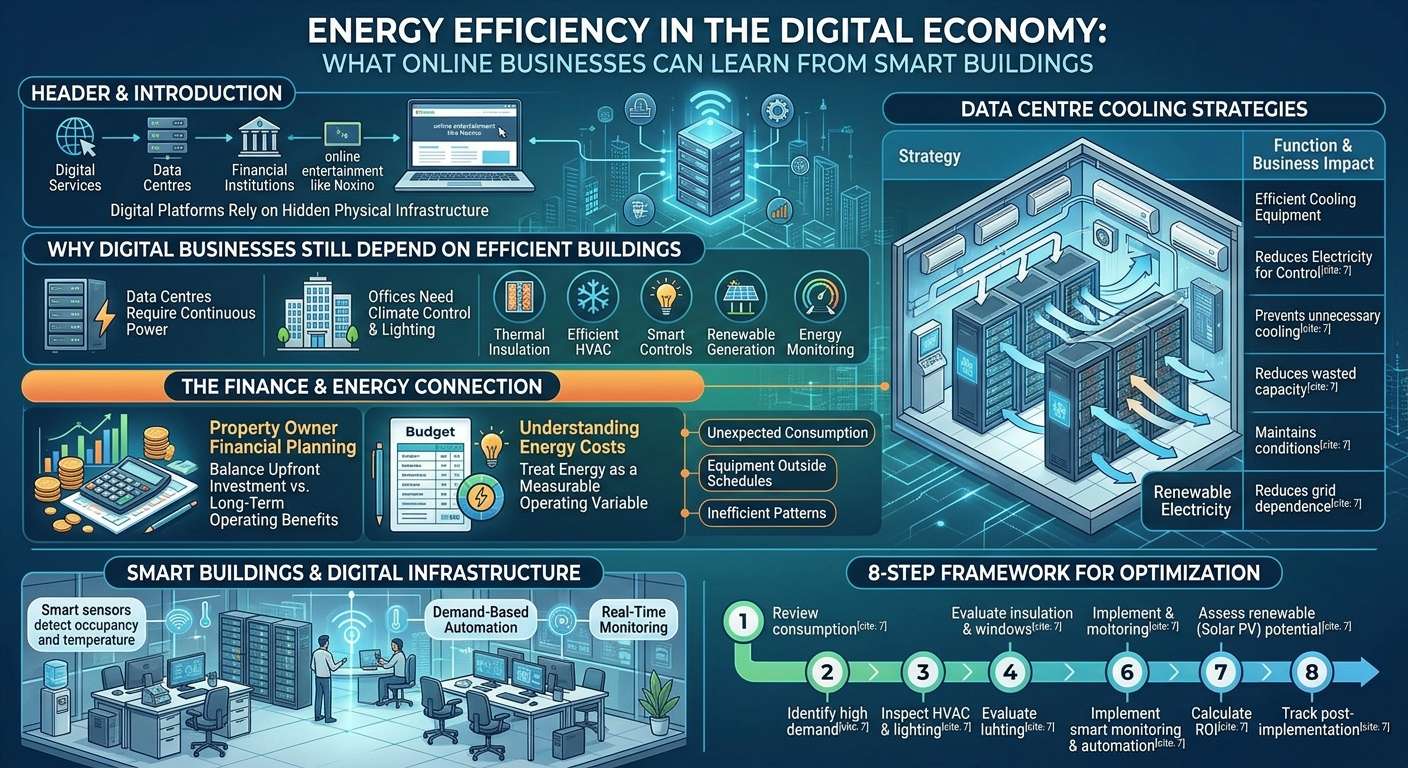
Energy efficiency is no longer limited to residential properties or traditional commercial buildings. As businesses increasingly depend on digital services, the relationship between physical infrastructure and online activity has become more important. Offices, data centres, financial institutions, and technology-driven entertainment platforms all rely on buildings and electrical systems that must operate efficiently and reliably.
The growth of digital finance, cryptocurrency services, and online entertainment illustrates this changing environment. Although many online businesses do not require customers to enter a physical venue, their services still depend on servers, networking equipment, cooling systems, offices, and other energy-consuming infrastructure. For users exploring digital entertainment such as a Noxino online casino, the visible website is only one part of a much larger technological ecosystem operating behind the screen.
Why Digital Businesses Still Depend on Efficient Buildings
A digital business may appear to exist entirely online, but its physical infrastructure remains essential. Data centres require continuous electricity, while offices and technical facilities need lighting, ventilation, air conditioning, and reliable power distribution.
For property owners hosting technology-oriented companies, energy performance can therefore have a direct influence on operational costs. A building with poor insulation or inefficient HVAC equipment can increase expenditure even when the primary business activity takes place through computers and cloud-based systems.
Several building characteristics can affect the efficiency of digital operations:
- Thermal insulation: Reduces unnecessary heat transfer.
- Efficient HVAC: Helps maintain suitable temperatures with less energy.
- LED lighting: Can reduce electricity consumption in offices and facilities.
- Smart controls: Adjust systems according to occupancy and actual demand.
- Renewable generation: Solar photovoltaic systems can offset part of electricity consumption.
- Energy monitoring: Provides information for identifying excessive consumption.
The Connection Between Finance and Energy Management
Financial Planning for Property Owners
Energy efficiency has an important financial dimension. Property owners must consider not only the initial cost of an improvement but also its expected operating benefits over time.
For example, replacing an outdated air-conditioning system may require a significant investment. However, if the new equipment uses substantially less electricity and requires less maintenance, the long-term operating profile of the building may improve.
This is particularly relevant for commercial properties occupied by businesses with extended operating hours. A company that depends on computers and technical equipment may require stable climate conditions throughout much of the day, making HVAC performance an important component of its operating budget.
Understanding Energy Costs as an Operating Variable
Energy expenses can fluctuate depending on consumption patterns, equipment efficiency, building characteristics, and electricity prices. Businesses can therefore benefit from treating energy consumption as a measurable operating variable rather than an unavoidable fixed expense.
Regular monitoring can help identify:
- Unexpected increases in electricity consumption.
- Equipment operating outside normal schedules.
- Inefficient heating or cooling patterns.
- Areas where energy-saving improvements may be appropriate.
- Opportunities to shift or reduce unnecessary consumption.
This information can support more informed financial planning and property-management decisions.
Smart Buildings and Digital Infrastructure
Smart-building technology provides another connection between energy efficiency and the digital economy. Sensors, automated controls, and building-management systems can collect information about temperature, occupancy, lighting, and equipment performance.
Automation Based on Actual Demand
A conventional system may operate according to a fixed schedule regardless of whether a room is occupied. A smart system can use sensors to adjust heating, cooling, or lighting according to actual conditions.
For example, an office used by a technology company may have different occupancy levels throughout the week. Automated controls can reduce unnecessary energy use during periods when particular rooms or areas are empty.
Real-Time Monitoring
Energy monitoring systems can provide property managers with detailed information about consumption. Instead of waiting for a monthly electricity bill to reveal an increase, managers can identify unusual patterns much earlier.
This approach is particularly useful in larger buildings where multiple systems contribute to total consumption. Separating usage by area or equipment type can make it easier to determine where efficiency improvements should be considered.
Data Centres and the Importance of Cooling
Digital financial platforms, cryptocurrency services, and online entertainment businesses rely heavily on computing infrastructure. Data centres must maintain servers within appropriate environmental conditions, making cooling one of their significant energy considerations.
Efficient cooling design can involve several techniques:
| Strategy | Potential Function |
|---|---|
| Efficient cooling equipment | Reduces electricity required for temperature control |
| Airflow management | Helps prevent unnecessary cooling |
| Server optimisation | Reduces wasted computing capacity |
| Temperature monitoring | Helps maintain appropriate operating conditions |
| Renewable electricity | Can reduce dependence on conventional energy sources |
The exact solution depends on the facility, climate, equipment configuration, and operational requirements. Professional assessment is important because energy-saving measures must also maintain the reliability of critical digital systems.
Renewable Energy for Technology-Oriented Properties
Solar photovoltaic systems can provide another option for commercial properties supporting digital businesses. A suitable roof can potentially generate electricity during daylight hours, helping offset part of the building’s consumption.
However, solar installation should be considered as part of a broader energy strategy. Improving insulation, reducing unnecessary consumption, and upgrading inefficient equipment can sometimes be important steps before increasing on-site generation.
An energy assessment can help property owners understand the building’s current performance and identify which improvements deserve further consideration.
Energy Certification and Modern Business Decisions
Building energy certification provides useful information about a property’s energy characteristics. In Italy, the APE, or Attestato di Prestazione Energetica, plays an important role in describing the energy performance of buildings.
For businesses and property professionals, this information can contribute to broader decisions concerning property acquisition, renovation, leasing, and energy improvements. A building’s energy performance can become increasingly relevant as companies seek to control operating costs and meet sustainability objectives.
The same principle applies whether a property accommodates a conventional office, a financial technology company, or another digitally connected business.
A Practical Framework for Improving Efficiency
Property owners considering improvements can begin with a structured assessment rather than immediately purchasing new equipment.
A practical process can include:
- Reviewing current energy consumption.
- Identifying the largest areas of demand.
- Checking HVAC and lighting performance.
- Evaluating insulation and windows.
- Considering smart monitoring and automation.
- Assessing renewable-energy potential.
- Estimating investment costs and long-term operating effects.
- Monitoring results after improvements are implemented.
This approach helps connect technical building decisions with measurable financial considerations.
Building Efficiency in an Increasingly Digital Economy
The expansion of online finance, cryptocurrency, and digital entertainment does not eliminate the importance of physical infrastructure. Instead, it creates new reasons to examine how efficiently buildings, offices, and data facilities use energy.
For homeowners, businesses, and property professionals, energy efficiency is ultimately about understanding how a building performs and where improvements can make a practical difference. Combining energy certification, intelligent technology, renewable generation, and careful financial planning can help create properties that are better prepared for the demands of a digitally connected economy.
Se ritenete utile il contenuto di questa pagina condividetelo su Facebook o Twitter.
Tweet
 Via Galilei, 1
 +39 351 7828816